W. Edwards Deming spent his career trying to teach a single, uncomfortable truth: effort without knowledge is waste. 'It is not enough to do your best,' he wrote. 'You must know what to do, and then do your best.'
For small businesses navigating federal contracting, infrastructure delivery, and complex operational environments, this distinction between effort and knowledge isn't academic philosophy. It's the difference between organizations that improve and organizations that merely survive.
We have dashboards. We have reports. We have spreadsheets tracking every conceivable metric. And yet — we're not improving. Not really. Not in the ways that compound.
The constraint isn't information. The constraint is knowledge.
The Illusion of Knowing
Every small business owner knows the feeling: you're drowning in data while starving for insight.
You can tell me last month's revenue to the penny. You can show me utilization rates, proposal win percentages, customer satisfaction scores. The numbers are there, updated daily, available on demand.
But ask a different kind of question — Why did we lose that contract? What system produced that quality issue? Which process creates friction that we've simply normalized? — and suddenly the dashboards go quiet.
This is what Deming meant when he said, 'Information is not knowledge. Let's not confuse the two.'
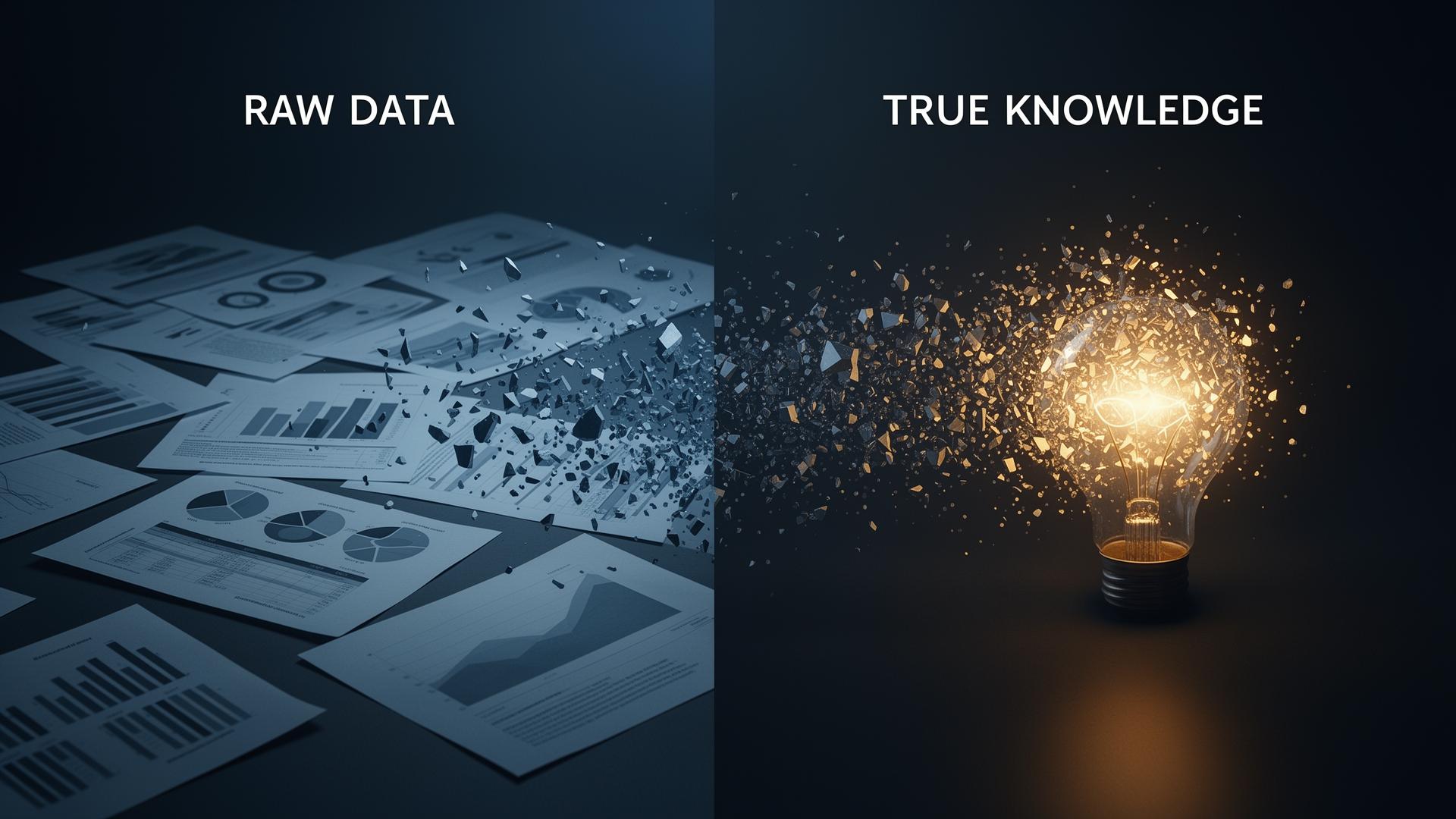
Information tells you what happened. Knowledge tells you why it happened and how to change it. Information is the symptom. Knowledge is the diagnosis.
Most organizations mistake the first for the second. They collect information religiously, present it professionally, and assume that the act of measurement produces the insight necessary for improvement. It doesn't.
The data tells you that 40% of your proposals lose. Knowledge tells you which proposals you should never have submitted in the first place.
The data shows employee turnover at 25%. Knowledge reveals which management behaviors drive the departures — and which you've been unwilling to confront.
The data reports project delays. Knowledge exposes the coordination failures that produce them before they become visible in the schedule.
The illusion of knowing is perhaps the most expensive constraint a small business can carry. You believe you understand your operation because you can see numbers moving on a screen. But you don't understand the system that produces those numbers. And without that understanding, improvement is accidental at best.
Information ≠ Knowledge
Deming's framework — what he called the System of Profound Knowledge — rests on four interconnected elements: appreciation for a system, knowledge of variation, theory of knowledge, and psychology. Most business education ignores all four.
We're taught to manage by metrics. Set targets. Measure results. Reward achievement. Punish failure. This approach assumes that the numbers tell the story and that people respond predictably to incentives.
The approach is wrong. Dangerously wrong.
Systems create outcomes, not individuals. When a worker underperforms, the instinct is to blame the worker. But Deming demonstrated repeatedly that 85-95% of performance variation is attributable to the system, not the individual. Fire the 'underperformer' and the replacement will produce similar results — because the system that created the problem remains unchanged.
Variation is normal, not aberrant. Every process has natural variation. Reacting to every fluctuation in a metric creates chaos, not improvement. Understanding which variation is systemic and which is special cause requires statistical thinking that most managers never develop.
You cannot manage what you do not understand. This is the deepest cut. Managers believe they understand their operations because they can see the outputs. But seeing outputs is not understanding the process that creates them. As Deming put it: 'If you can't describe what you are doing as a process, you don't know what you're doing.'
In federal contracting environments, this gap between information and knowledge becomes acute. Small businesses collect the data required for compliance — labor hours, cost reports, performance metrics — without developing the knowledge necessary to actually improve. The reporting infrastructure exists. The learning infrastructure doesn't.
The Right Questions
Why do organizations measure the wrong things? Because they ask the wrong questions.
'What can we measure?' is the wrong question. It leads to tracking whatever is convenient, visible, and quantifiable — which is rarely what matters most.
'What do we need to understand?' is the right question. It leads to investigating the systems, behaviors, and relationships that actually determine outcomes.
The most important things cannot be measured. Deming said this provocatively, knowing it would challenge the measurement-obsessed business culture. He wasn't arguing against measurement. He was arguing against the delusion that everything important can be captured in a number.
How do you measure trust between a prime contractor and a subcontractor? You can track contract compliance, on-time delivery, quality metrics. But the trust that enables a phone call to resolve a problem before it becomes a change order? That lives outside the spreadsheet.
How do you measure the institutional knowledge that walks out the door when a senior estimator retires? You can count the proposals they worked on, the win rate of those bids. But the judgment about which opportunities to pursue and which to decline? That's not in the database.
How do you measure the psychological safety that allows a field technician to report a near-miss before it becomes an incident? You can track incident rates — but by then, you're measuring failures, not the conditions that prevent them.
Most businesses measure what's easy rather than what matters. Revenue is easy. Customer lifetime value is hard. Hours worked is easy. Productive capacity is hard. Training attendance is easy. Competency development is hard.
The organizations that develop genuine knowledge discipline themselves to pursue the hard measurements — the ones that require observation, conversation, and judgment rather than just data extraction.
Theory of Knowledge in Practice
Deming's 'theory of knowledge' is epistemological: how do we know what we know? In practical terms, it means this: you cannot improve a system without a theory about how it works.
Observation without theory is just watching things happen. You see patterns but don't know which are causal and which are coincidental. You make changes but can't predict their effects. You're experimenting without a hypothesis.
'If you do not know how to ask the right question, you discover nothing.' This Deming principle applies directly to small business operations. The questions you ask determine the knowledge you develop.
Wrong question: 'Why is productivity low?' (assumes productivity is the constraint)
Right question: 'What system produces our current output, and where is the actual constraint?'
Wrong question: 'How do we reduce costs?' (assumes cost is the problem)
Right question: 'What creates waste in our process, and what would it cost to eliminate it?'
Wrong question: 'Who is responsible for this failure?' (assumes individual blame)
Right question: 'What conditions allowed this failure to occur, and what would prevent recurrence?'
The discipline of forming explicit theories — stating clearly what you believe about how your system works — is uncomfortable. Theories can be wrong. Stating them exposes your assumptions to challenge. Most managers avoid this discomfort by relying on implicit theories they never articulate.
But implicit theories are still theories. They just operate below the surface, shaping decisions without examination. Making them explicit is the only way to test and improve them.
In our own work, we've adopted a practice of stating our theories before making significant changes. 'We believe that field technicians delay reporting problems because they expect blame rather than support. If we change our response to early problem reports — celebrating the disclosure rather than investigating fault — we predict report frequency will increase and problem severity at discovery will decrease.'
This theory might be wrong. But stating it creates the conditions for learning. If we make the change and reports don't increase, we've learned something about our actual culture. If reports increase but severity doesn't decrease, we've learned something about our problem-detection process. Either way, we're building knowledge rather than just reacting to symptoms.
Workaround Discovered
Through our experience building coordination infrastructure for federal and commercial clients, we've developed practices that address the knowledge constraint directly:
Document the theory, not just the procedure. Standard operating procedures typically describe what to do. Our approach adds why — the theory that makes the procedure make sense. When people understand the reasoning, they can adapt when circumstances change. When they only know the steps, they follow them blindly even when they no longer apply.
Create learning loops, not just reporting loops. Most organizations have extensive reporting infrastructure. Data flows upward, gets summarized, appears in dashboards. But learning requires the loop to close — insights flowing back down, changing behavior, and producing different data. We design systems with explicit learning mechanisms: regular reviews that ask 'what did we learn?' rather than just 'what happened?'
Invest in question-asking capability. The ability to ask the right question is a skill that can be developed. We train teams to distinguish between symptom questions ('why did this fail?') and system questions ('what conditions produce this type of failure?'). The shift is subtle but transformative.
Make institutional knowledge visible. The expertise that senior people carry in their heads needs to be externalized before it walks out the door. This isn't about documentation for documentation's sake — it's about capturing the judgment, the patterns, the 'how do you know?' that turns information into knowledge. We use structured knowledge capture sessions that go beyond procedure documentation to capture decision-making reasoning.
Build prediction into operations. Before we change anything significant, we make predictions. 'We expect this change to produce X result within Y timeframe.' Then we track. Were we right? If not, what did our wrong prediction reveal about our understanding of the system? This simple practice converts every operational change into a learning opportunity.
The Path Forward
The knowledge constraint is not solved by collecting more data, buying better dashboards, or hiring analysts. It's solved by developing genuine understanding of the systems that produce your outcomes.
This requires humility. 'You don't know what you don't know' — Deming's blunt assessment — applies to all of us. The organizations that improve fastest are the ones most willing to acknowledge their ignorance and pursue understanding systematically.
It requires discipline. Forming explicit theories, testing them against reality, revising them when proven wrong — this is harder than simply reacting to whatever the metrics show. But it's the only path to knowledge that compounds.
It requires patience. Knowledge development is slower than information collection. You can install a new dashboard in a week. Developing genuine understanding of your operation takes months or years. The investment pays returns, but not immediately.
The constraint isn't that we lack information. We're drowning in information. The constraint is that we haven't converted that information into knowledge — the understanding of variation, systems, and causation that enables genuine improvement.
Small businesses that develop this knowledge capability will outperform those that don't. Not because they work harder — everyone works hard. Because they know what to work on.
'It is not enough to do your best,' Deming reminded us. 'You must know what to do, and then do your best.'
That's the work. That's the constraint. And addressing it is the most valuable investment any organization can make.