This is the last article in the Constraint Series. Not because we've run out of constraints to name — but because we've found the one that generates all the others.
Over the past several months, we've published articles on knowledge, coordination, trust, talent, technology, sequencing, design, founders, signals, career stacks, coordination cost, constraint visibility, and Human Integration Overhead. Each described a real friction. Each identified a real bottleneck. Each proposed a real response.
But none of them named the root cause.
Today, we name it: The Human Synthesis Constraint.
The Architectural Flaw
Construction did not set out to make the human brain its integration layer. It happened by default.
Every decade brought new tools. Scheduling software in the 1990s. Document management in the 2000s. Field reporting apps in the 2010s. AI-powered analytics in the 2020s. Each tool solved a real problem in isolation. Each created a new silo in practice.
Nobody designed a system to connect them. So humans did it themselves — manually, cognitively, every day, on every project.
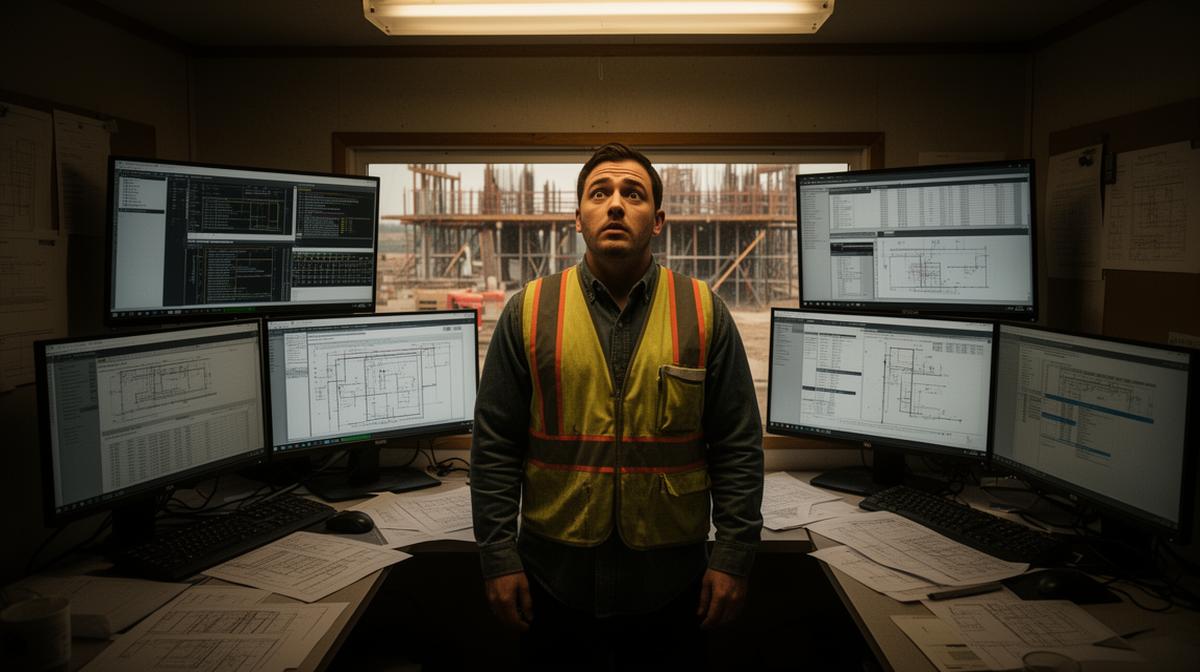
The superintendent became the router. The project manager became the translator. The estimator became the reconciler. The foreman became the memory. Not because those were their roles, but because no system existed to perform synthesis across the fragmented information landscape.
This is the Human Synthesis Constraint: the industry's implicit decision to use human cognition as the integration architecture for all project information.
It was never a conscious choice. Nobody sat in a boardroom and said, 'Let's make the superintendent responsible for mentally merging data from eight platforms every morning.' It simply happened — tool by tool, platform by platform, year by year — until the human brain became the only place where the full picture of a project existed.
Why Every Other Constraint Traces Here
Go back through the series. Every constraint we named is a downstream effect of the Human Synthesis Constraint:
[Knowledge as Constraint](/articles/knowledge-as-constraint) exists because institutional knowledge lives in human synthesis patterns — in the experienced PM's ability to mentally connect a current RFI to a decision made three months ago. When that person leaves, the synthesis capacity leaves with them. The knowledge isn't lost because it wasn't documented. It's lost because it was never externalized — it existed only as a pattern in someone's head.
[Coordination as Constraint](/articles/coordination-is-the-constraint) exists because coordination requires synthesis — merging schedules, progress, issues, and decisions from multiple trades into a coherent picture. When synthesis is manual, coordination speed is limited by how fast one human can integrate fragmented inputs. Add more trades, and you don't get linear scaling — you get exponential synthesis load.
[Trust as Constraint](/articles/trust-as-constraint) exists because verification requires synthesis. The 'epistemic gap' we described — the distance between what someone claims and what you can verify — is a synthesis gap. Closing it requires manually assembling evidence from multiple sources. When synthesis is hard, trust erodes, because verification is too expensive to perform consistently.
[Talent as Constraint](/articles/talent-as-constraint) exists because the industry's most critical 'skill' is actually synthesis capacity. The reason experienced superintendents are irreplaceable isn't their technical knowledge alone — it's their ability to mentally hold and integrate information from dozens of sources simultaneously. You can't hire for that. You can't train it in six months. It takes years to develop, and it walks out the door at retirement.
[Technology as Constraint](/articles/technology-as-constraint) exists because each new tool adds another input to the synthesis load. The promise was efficiency. The reality is that every new platform creates another information island that requires more human synthesis to connect. Technology didn't solve the integration problem — it multiplied it.
[Sequencing as Constraint](/articles/sequencing-as-constraint) exists because correct sequencing requires synthesizing dependencies across trades, materials, inspections, and spatial conflicts simultaneously. When that synthesis lives in one superintendent's head, you get Dependency Blindness, Spatial Failure, and Material-Sequence Mismatch — not because the information doesn't exist, but because no single human can synthesize it all in real time.
[Design as Constraint](/articles/design-as-constraint) exists because interfaces mirror database schemas instead of decision patterns — forcing users to mentally translate between how the system stores information and how they actually think about their work. Every bad interface is a synthesis demand: figure out what this screen means in the context of what you're actually trying to do.
[The Founder as Constraint](/articles/removing-founder-as-constraint) exists because in small organizations, the founder becomes the only person with sufficient synthesis capacity to integrate all the moving parts. The business grows until it exceeds one person's cognitive bandwidth. That's not a management problem. It's a synthesis ceiling.
[Human Integration Overhead](/articles/human-integration-overhead) — the article that preceded this one — named the cost of manual synthesis. This article names the architectural decision that created that cost.
The Integration Layer Nobody Designed
In software engineering, there's a principle: every system needs an integration layer. Something has to connect the database to the interface, the interface to the business logic, the business logic to the external APIs. If you don't design that layer intentionally, it emerges accidentally — usually as spaghetti code that nobody can maintain.
Construction has spaghetti integration. The human brain is the middleware. And like all accidental architecture, it has severe limitations:
It doesn't scale. One superintendent can synthesize information for a $5M project. The same person cannot synthesize for a $50M project without fundamental system changes. The brain doesn't parallelize.
It doesn't persist. When the synthesizer goes home, gets sick, retires, or quits, the synthesis capacity disappears. There's no backup. There's no failover. The 'system' has a single point of failure, and it's a person.
It doesn't transfer. You can't export synthesis patterns from one brain to another. Onboarding a new PM to a complex project takes months — not because the information is secret, but because rebuilding the synthesis context is a cognitive construction project in itself.
It doesn't verify itself. Human synthesis is invisible. You can't audit it. You can't test it. You can't prove that the picture in someone's head matches reality. The only verification method is to ask a second person to perform the same synthesis independently — which doubles the overhead.
It degrades under load. Cognitive synthesis quality drops with fatigue, stress, information volume, and time pressure — precisely the conditions that define construction project environments. The integration layer performs worst exactly when you need it most.
The Synthesis Tax
In Coordination Cost as a Line Item, we estimated that coordination waste consumes 15–25% of project cost. That number is the Synthesis Tax — the price the industry pays for using human cognition as its integration architecture.
But the Synthesis Tax isn't just financial. It's existential:
It caps organizational growth. You can only take on projects that your synthesis capacity can handle. Growth doesn't require more capital or more people — it requires more synthesis bandwidth. And synthesis bandwidth is the scarcest resource in the industry.
It creates brittleness. When synthesis lives in individual brains, every personnel change is a system failure. Projects don't just lose a person — they lose the integration layer. Recovery isn't about hiring a replacement. It's about reconstructing the synthesis context that the previous person held.
It prevents learning. If synthesis patterns never leave individual brains, the organization can't learn from them. You can't analyze synthesis failures you can't see. You can't improve integration patterns you can't externalize. The organization is stuck at the capability level of its most experienced synthesizer.
It hides the real constraint. When every problem looks like it requires a better person — a more experienced super, a more organized PM, a more responsive foreman — you never see the architectural problem underneath. You keep trying to find better humans to serve as integration middleware, instead of building a system that removes the synthesis burden from humans entirely.
The Groundline AI Thesis
Groundline AI exists because of a single architectural conviction: the human brain should not be the integration layer for project information.
This isn't a technology pitch. It's a systems architecture argument.
When we designed Groundline AI's four-layer architecture — Data Intake, Intelligence Engine, Operational Modules, Visibility & Governance — we weren't building a better tool. We were building the integration layer that construction never had.
Data Intake replaces human polling. Instead of a superintendent manually checking eight systems to establish current reality, the platform normalizes all data sources into a unified pipeline. Reality assembly becomes a system function, not a cognitive one.
Intelligence Engine replaces human context reconstruction. Instead of detective work to recover the why behind a decision, the platform maintains persistent context — timestamped, linked, searchable. Institutional memory becomes infrastructure, not a person.
Operational Modules replace human translation labor. Instead of manually converting between work packages and cost codes, between field activity IDs and schedule tasks, the platform maintains unified data models that eliminate the translation step entirely.
Visibility & Governance replaces human verification. Instead of manually assembling evidence to prove what happened, the platform creates audit trails automatically — linked evidence chains that close the epistemic gap without requiring a second human to re-synthesize.
The result isn't that humans do less. It's that humans do different work — the work that actually requires human judgment: leading teams, solving novel problems, making decisions with incomplete information, building relationships, exercising wisdom.
The Capstone Argument
Here's the thesis of the entire Constraint Series, condensed to its essence:
Every constraint in construction is a symptom of one architectural flaw: the industry uses human cognition as its system integration layer. Knowledge leaks because synthesis isn't externalized. Coordination breaks because synthesis doesn't scale. Trust erodes because synthesis can't be verified. Talent is scarce because synthesis capacity takes years to develop. Technology fragments because each new tool adds synthesis load. Sequencing fails because real-time multi-variable synthesis exceeds cognitive bandwidth. Design fails because interfaces demand translation instead of supporting decision-making.
The solution is not better humans. It's not more training. It's not another app.
The solution is an integration architecture that moves synthesis from human cognition into structured systems — preserving human judgment for the work that only humans can do, while eliminating the cognitive pre-work that currently consumes 40–60% of every experienced professional's day.
That's what Groundline AI builds. That's what the Constraint Series has been building toward. And that's why this is the last article in the series — not because the work is done, but because the diagnosis is complete.
The Human Synthesis Constraint is the root cause. Everything else is downstream.
What Comes Next
The Constraint Series is finished. But the work isn't.
With the diagnosis complete, the next phase is prescriptive: showing how organizations can systematically reduce their synthesis burden, measure the results, and reinvest the recovered cognitive capacity into the judgment-work that drives real value.
We'll publish case studies. We'll share implementation frameworks. We'll demonstrate what happens when the integration layer shifts from human cognition to structured systems — not in theory, but in practice, on real projects, with real teams.
But that's a different series. This one ends where it began: with the recognition that the most expensive thing in construction isn't labor, materials, or equipment.
It's the synthesis tax your best people pay every day — because nobody built the integration layer they deserved.