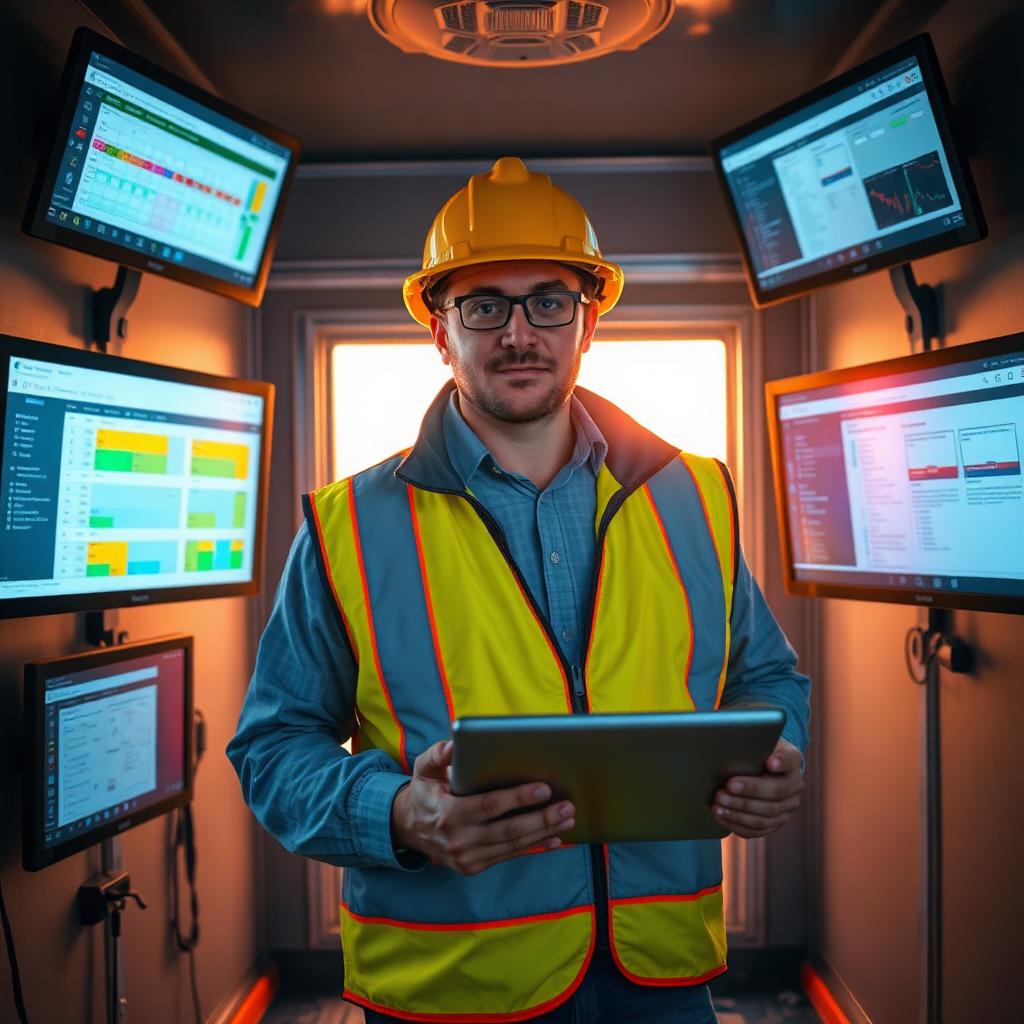
There's a particular kind of frustration that shows up in almost every conversation we have with small and mid-size contractors. It's not about a lack of tools. It's about a surplus of them — and the organizational impossibility of making them work together.
The scheduling lives in one system. Procurement lives in another. Safety documentation is a third. Daily reports are a fourth. Photos go to a cloud folder nobody organizes. Meeting notes live in someone's inbox. And the actual coordination — the part where all of this needs to become a coherent operational picture — happens in group texts, phone calls, and the project manager's head.
This article is about that gap. Not the gap between technology and possibility, but the gap between available technology and organizational capacity to use it. Because in infrastructure, technology itself has become a constraint — not because the tools don't exist, but because the ecosystem that delivers them was never designed for the organizations that need them most.
The Paradox of Abundance
We are living through a period of extraordinary technological capability. The construction and infrastructure sectors have more purpose-built software than at any point in history. Scheduling platforms. Procurement automation. Safety management. Document control. Reality capture. BIM coordination. AI-powered analytics. Drone inspection. IoT sensors.
Each tool is genuinely impressive in isolation. Each solves a real problem. Each was built by smart people who understand their specific domain deeply.
And yet field operations are more fragmented than ever.
The 2023 JBKnowledge Construction Technology Report found that the average trade contractor uses 4-7 distinct software platforms, with less than 30% reporting meaningful integration between them. A McKinsey study on construction productivity found that the industry has seen only 1% annual productivity growth over the past two decades — despite billions invested in technology.
The paradox is real: more tools, less coherence. More data, less clarity. More capability on paper, less capacity in practice.
This isn't a technology problem. It's a coordination problem disguised as a technology problem. And that distinction matters enormously for how you respond to it.
The Domain Silo Problem
Every major construction technology platform owns a vertical slice of the operational picture:
Procore owns project management and documentation. Kojo owns material procurement and tracking. Bluebeam owns plan review and markup. Fieldwire owns task management and field coordination. Autodesk Construction Cloud owns BIM and design collaboration. SafetyCulture owns inspections and checklists. Raken owns daily reporting.
Each platform does its job well. But here's the structural problem: none of them own the horizontal coordination layer. None of them are responsible for ensuring that the schedule change in Platform A triggers the procurement adjustment in Platform B, which updates the safety plan in Platform C, which modifies the daily report template in Platform D.
That connective tissue — the part where information flows between domains and creates a unified operational picture — is treated as someone else's problem by every vendor in the ecosystem.
The integration promises are real but hollow. Most platforms advertise 'integrations' that amount to webhook notifications, CSV exports, or Zapier connections that break when either platform updates. These aren't integrations — they're acknowledgments that the problem exists, wrapped in marketing language.
The result is what we call the domain silo problem: each tool creates its own version of truth, its own data model, its own workflow assumptions. The project manager becomes the human integration layer — manually reconciling information across platforms, re-entering data, translating between systems, and maintaining the mental model that no single tool provides.
This is not sustainable. And it's not scalable.
The Organizational Capacity Gap
Here's the part that most technology vendors don't want to talk about: their tools were designed for organizations that have IT departments, integration teams, and change management budgets.
Top-tier national general contractors can afford to hire technology directors, build custom integrations, and run six-month adoption programs. They have the organizational capacity to absorb the overhead of multi-platform environments.
Small and mid-size trade contractors cannot.
Consider the typical 30-person mechanical or electrical contractor. The project manager is also the estimator. The superintendent is also the safety officer. The office manager is also the bookkeeper, the HR department, and the IT help desk. Nobody's job title includes 'technology integration specialist' because the company can't afford that role.
When you sell a tool to this organization, you're not just selling software. You're selling a change management project that nobody has bandwidth to run.
The vendor says: 'It's intuitive! Your team will love it!' What the vendor means is: 'It's intuitive for someone who has time to learn it, a workflow that accommodates it, and colleagues who will adopt it simultaneously.'
What the contractor hears is: 'Here's another login to manage, another system to maintain, another training session to schedule, another monthly subscription to justify, and another thing that will work great for three months until the one person who understood it leaves.'
This capacity gap is not laziness or technophobia. It's rational resource allocation by organizations with zero slack in their operating model. When every person is already at 110% utilization, the cognitive cost of adopting new technology often exceeds the operational benefit — especially when the benefit only materializes if everyone adopts it simultaneously.
The Hidden Cost of Tool Fatigue
There's a term in behavioral economics called 'decision fatigue' — the degradation of decision quality after a long series of choices. Something similar happens with technology adoption in small organizations. We call it tool fatigue.
Tool fatigue manifests in predictable ways:
The Graveyard of Logins. Every failed adoption leaves behind an active subscription, a partially populated database, and a team that's slightly more skeptical of the next tool. We've walked into contractor offices with six active SaaS subscriptions that nobody uses, costing $15,000-30,000 annually in pure waste.
The Reversion to Analog. When the third 'game-changing' platform fails to stick, crews revert to what they know works: whiteboards, notebooks, group texts, phone calls. This isn't regression — it's organizational self-preservation. The analog methods are slow and error-prone, but they're understood, trusted, and don't require training.
The Trust Tax. Each failed tool adoption doesn't just waste money — it erodes the organization's willingness to try the next thing. This creates a compounding trust deficit where genuinely useful tools get rejected because the organization has been burned too many times. In our article on Trust as Constraint, we explored how epistemic safety is the precondition for adoption. Tool fatigue is the mechanism by which that safety is destroyed.
The Opportunity Cost of Evaluation. Simply evaluating technology takes time that small contractors don't have. Demos, trials, configuration, testing — even the decision process consumes bandwidth that could go toward billable work. When the average tool takes 2-4 weeks to evaluate properly and 60-90 days to adopt, the opportunity cost is significant.
The total cost of tool fatigue — subscriptions, failed implementations, retraining, evaluation overhead, and trust erosion — is invisible on most financial statements. But it's one of the largest hidden taxes on small contractor operations.
The AI Promise and the AI Reality
The current wave of AI-powered solutions adds a new dimension to the technology constraint. Large language models, computer vision, predictive analytics, and autonomous agents are being positioned as transformative for construction.
And many of them genuinely are — in the right context, at the right scale, with the right organizational support.
But each AI solution has its own domain assumptions:
Scheduling AI assumes structured data inputs that most small contractors don't produce. Procurement AI requires purchase order discipline that many teams haven't implemented. Safety AI needs consistent photo documentation that field crews don't always capture. Document AI works brilliantly on standardized forms but struggles with the handwritten notes and ad-hoc communications that constitute much of field coordination.
The fundamental problem isn't that AI doesn't work. It's that each AI solution works within its own domain, on its own data model, according to its own assumptions — and nobody has solved the integration layer between them.
For a 30-person contractor, the AI landscape looks like this: twelve vendors, each promising to revolutionize one aspect of operations, each requiring clean data that the other eleven systems produce in different formats, and none of them talking to each other.
The promise is automation. The reality is more complexity in the gap between tools.
The Missing Middle Layer
This is the problem Groundline AI was built to solve. Not as another vertical tool competing for a domain — but as the coordination engine that sits between domains.
Our architecture reflects a fundamentally different design philosophy:
We don't replace your scheduling tool. We ingest its output. We don't replace your procurement platform. We normalize its data. We don't replace your safety system. We correlate its signals with everything else happening on the project. We don't replace your daily reports. We extract structured intelligence from them.
The Groundline platform operates on a four-layer model: Data Intake → Intelligence Engine → Operational Modules → Visibility & Governance.
Layer 1: Data Intake. A normalized pipeline that accepts eight source types — GC schedules, work packages, owner equipment data, daily reports, field issues, meeting transcripts, email archives, and material tracking (Kojo). We don't demand that contractors change how they produce data. We meet them where they are.
Layer 2: Intelligence Engine. Autonomous processing that classifies, routes, decomposes, and extracts actionable information. Email gets classified. Tasks get decomposed. Quotes get extracted. Meeting decisions get captured. None of this requires the contractor to do anything differently — the intelligence layer operates on the data they're already producing.
Layer 3: Operational Modules. Five functional modules — Work Packages, Purchase Readiness, Field Issues, Schedule Alignment, and Meeting Intelligence — that provide the coordination views no single vertical tool can offer. These aren't new workflows to learn; they're windows into the work you're already doing, finally made visible in one place.
Layer 4: Visibility & Governance. A unified event stream and timestamped audit trail that converts operational activity into verifiable evidence. Every decision, every change, every approval — documented, time-stamped, and audit-ready.
The key insight is architectural: Groundline doesn't compete with your existing tools. It makes them work together. It's the horizontal coordination layer that the vertical vendors assume someone else provides.
This is what 'Capture → Connect → Convert' means in practice: we capture the data your existing tools and workflows already produce, we connect it into a unified operational picture, and we convert it into the audit-ready evidence that protects your margin and proves your performance.
What 'Human-Led, AI-Enabled' Actually Means
There's a reason our tagline isn't 'AI-Powered' or 'Autonomous.' It's 'Human-Led. AI-Enabled. Audit-Ready.'
Here's what that means operationally:
The AI extracts, routes, and documents. Humans decide. When our Intelligence Engine processes a meeting transcript, it identifies decisions, action items, and schedule implications. It doesn't make the decision — it surfaces the decision that was made and ensures it's captured, attributed, and tracked.
The AI normalizes, correlates, and flags. Humans investigate. When the system detects that a schedule change in the GC's master schedule affects three active work packages and two pending material orders, it flags the correlation. The project manager decides what to do about it.
The AI creates audit trails automatically. Humans review and approve. The system timestamps every event, every change, every communication. But the governance framework ensures that human judgment — not algorithmic confidence — drives final documentation.
This matters because the contractors we serve — the ones experiencing technology as a constraint — have been burned by tools that demanded they conform to the software's logic rather than the other way around. In our article on Trust as Constraint, we identified 'epistemic safety' as the precondition for tool adoption. Groundline earns that trust by keeping humans in control of every decision while removing the manual burden of documenting those decisions.
The AI serves the operator's existing workflow. It doesn't demand that the superintendent learn a new interface. It doesn't require the PM to change how they run meetings. It doesn't insist that field crews adopt a specific photo documentation protocol. It works with what exists and makes it coherent.
From Tool Accumulation to Operational Integration
The maturity signal for technology isn't 'We use Procore' or 'We just got an AI tool.' The maturity signal is: 'Our systems produce a unified audit trail without anyone doing double-entry.'
Here's what the progression looks like:
Stage 1: Tool Accumulation — The organization acquires tools reactively, each solving an immediate pain point. No integration strategy. High overlap. Growing subscription costs. The PM is the human integration layer.
Stage 2: Selective Consolidation — The organization evaluates its tool stack honestly (as we described in Technology Readiness for Operators) and eliminates redundancy. Some tools are retired. Others are standardized. The stack gets simpler, but the integration gaps remain.
Stage 3: Coordination Layer — The organization implements a horizontal coordination platform that connects the remaining vertical tools into a unified operational picture. Data flows between systems. The PM is freed from manual reconciliation. Audit trails are automatic.
Stage 4: Intelligence Integration — The coordination layer develops enough contextual understanding to surface insights, flag risks, and recommend actions proactively. The organization moves from reactive information gathering to anticipatory intelligence. This is where Organizational Foresight becomes possible — because you can't see around corners if you can't see what's happening now.
Most small contractors are stuck at Stage 1 or early Stage 2. Not because they lack ambition or intelligence, but because the leap from accumulation to integration requires a type of infrastructure — the coordination layer — that didn't exist until recently.
The Institutional Dimension
For contractors working in federal and institutional markets, technology integration isn't just an operational advantage — it's a compliance requirement that's rapidly becoming a competitive differentiator.
Federal buyers are increasingly evaluating technology maturity in proposals. The ability to demonstrate automated compliance documentation, real-time project visibility, and audit-ready evidence trails is moving from 'nice to have' to 'evaluation criteria.'
The VA's EHRM (Electronic Health Record Modernization) rollout demonstrated what happens when technology integration fails at institutional scale. Billions in cost overruns. Interoperability failures. Data migration disasters. The lesson for contractors: if you can demonstrate that your technology stack produces coherent, auditable, integrated outputs, you're speaking the language that federal buyers are desperate to hear.
This is why we built Groundline as a coordination engine rather than another project management tool. Federal evaluators don't need to see that you use software. They need to see that your systems produce verifiable evidence of performance, coordination, and compliance — automatically, consistently, and without the manual overhead that creates errors.
What This Means for You
If you're a small or mid-size contractor reading this, here's the honest assessment:
The technology constraint is real, but it's not what the vendors tell you it is. Your constraint isn't that you need more tools. It's that you need the tools you already have to work together in a way that doesn't depend on one person's heroic effort to reconcile them.
The AI wave is real, but most of it isn't built for you. Not yet. The solutions designed for enterprise organizations with dedicated IT staff and change management budgets will continue to disappoint at your scale — unless they're architected specifically for the coordination gap you experience every day.
The path forward isn't tool adoption — it's operational integration. The question to ask isn't 'What new tool do we need?' It's 'How do we make what we already have produce a coherent picture without manual intervention?'
That's the constraint we're removing. Not by adding another tool to the stack, but by providing the coordination layer that makes the entire stack work as one system.
Capture. Connect. Convert.
The technology was never the constraint. The gap between the tools was.
---
This article is part of our ongoing [Constraints Series](/articles?category=Constraints), exploring the systemic bottlenecks that limit small business growth in infrastructure. Previous entries examined the [founder](/articles/removing-founder-as-constraint), [coordination](/articles/coordination-is-the-constraint), [trust](/articles/trust-as-constraint), [knowledge](/articles/knowledge-as-constraint), [talent](/articles/talent-as-constraint), [small business structure](/articles/small-business-as-constraint), and [organizational foresight](/articles/organizational-foresight-as-maturity-signal) as constraints. Each article reflects operational experience, not theory — observations from the work itself.
For a practical companion to this piece, see [Technology Readiness for Operators](/articles/technology-readiness-operators) — our tactical guide to evaluating and rationalizing your tech stack.