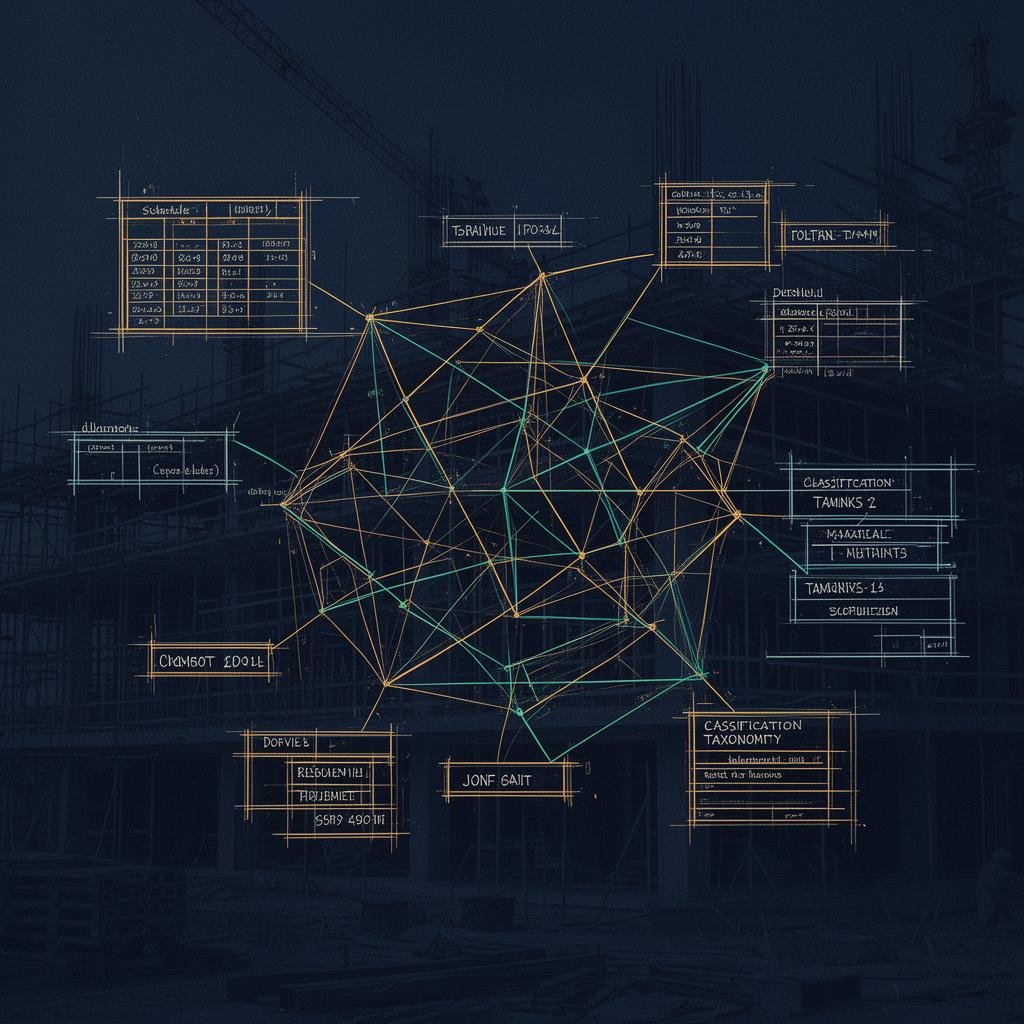
Every construction project generates thousands of data points. Schedules, RFIs, submittals, daily reports, emails, change orders, purchase orders, meeting minutes, field photos, inspection reports. The volume isn't the problem. The problem is that nobody agrees on how those data points relate to each other.
This is the ontology problem. And it's the constraint that makes every other constraint worse.
What Is a Project Ontology?
An ontology is a classification system — a shared vocabulary and grammar — that defines how all entities in a project relate to each other. In construction terms, it's the structural agreement about what connects to what:
A Project has Work Packages. Work Packages have Tasks. Tasks are assigned to Crews. Crews consume Materials. Materials require Purchase Orders. Purchase Orders reference Quotes. Quotes came from Vendor Emails. Vendor Emails reference a Scope Line that traces back to the original Bid.
That chain — from bid to email to quote to PO to material to crew to task to work package to project — is an ontology. It's a relational map that gives every piece of data a place, a context, and a connection to every other piece.
Most construction organizations don't have one.
The Eleven-Reality Problem
Without a shared ontology, every role in a trade contracting organization constructs its own mental model of how the project works. On a mission-critical project — a data center, a hospital, a pharmaceutical facility — the number of distinct realities isn't four or five. It's at least eleven.
### Field-Side Realities
The Trade Foreman sees the project through the lens of crew and task. Their mental model connects people to tools to daily work assignments. When they hear 'that material is late,' they think: what do I tell my guys to do today? Can I shift them to another task? Do I need to send anyone home? Their ontology is crew-centric.
The Field Engineer / QC Lead sees the project through inspections, punchlist, and quality compliance. When they hear 'that material is late,' they think: does the substitution meet spec? Who signs off? What documentation do I need before we can close this out? Their ontology is conformance-centric.
### Project-Level Realities
The Trade PM sees the project through scope, budget, and change management. When they hear 'that material is late,' they think: what's the cost exposure? Is there a change order? Who do I need to escalate to? Their ontology is scope-and-margin-centric.
The Estimator sees the project through bid-to-field traceability. When they hear 'that material is late,' they think: was this priced correctly in the original estimate? What did we carry for this line item? How does the actual compare to what we bid? Their ontology is bid-centric — and it often lives in a spreadsheet that nobody on the project team has ever seen.
### Home Office Realities
This is where the ontology problem multiplies — because home office roles support multiple projects simultaneously, each with its own classification chaos.
The Submittals Coordinator sees the project through spec compliance, approval chains, and transmittal logs. When they hear 'that material is late,' they think: was the submittal approved? Did the architect reject the first submission? Is there a resubmittal pending that nobody told me about? Their ontology is approval-centric — and they're tracking this across three or four projects at once.
The Closeout Manager sees the project through O&M manuals, as-builts, warranties, and attic stock. When they hear 'that material is late,' they think: does this substitution change the warranty documentation? Do I need updated cut sheets? Their ontology is deliverables-centric — and they usually inherit the problem months after everyone else has moved on.
The Scheduler / Planner sees the project through CPM logic, resource loading, and float. When they hear 'that material is late,' they think: which successor activities are impacted? What's the float on this path? Does the critical path shift? Their ontology is temporal.
The Shop / Fab Manager sees the project through fabrication drawings, material procurement, and prefab sequencing. When they hear 'that material is late,' they think: does this delay my fab schedule? Do I have the right spec revision? Is there a long-lead substitution I can cut instead? Their ontology is production-centric.
The Procurement / Expediter sees the project through purchase orders, lead times, and vendor commitments. When they hear 'that material is late,' they think: which PO is this on? What did the vendor confirm? When was the last expediting call? Their ontology is supply-chain-centric.
### Compliance & Executive Realities
The Safety Lead sees the project through compliance, exposure, and incident prevention. When they hear 'that material is late,' they think: does the crew have an approved task plan for the substitute? Are there new hazards? Is the SDS current? Their ontology is risk-centric.
The Owner / Principal sees the project through margin, backcharge recovery, and portfolio performance. When they hear 'that material is late,' they think: what's the P&L impact? Can we recover it? How does this affect our bonding capacity for the next bid? Their ontology is financial-strategic.
Eleven roles. Eleven mental models. Eleven classification systems. One project.
The Capacity Collapse
Here's what no project management framework talks about: those eleven realities don't each get a dedicated person.
In practice, the Trade PM is also covering estimator reconciliation because the estimator is already pricing the next bid. The submittals coordinator is managing closeout on two other projects simultaneously. The scheduler updates three projects and is always behind on all of them. The field engineer is splitting time between QC and assistant PM duties because the team is understaffed.
This is capacity collapse — the organizational reality where the number of perspectives a project demands exceeds the number of people available to maintain them. Everyone compresses. Everyone triages. Everyone operates in survival mode: address the contractual fire, document just enough to not get burned, move to the next crisis, and hope for the outcome.
The result isn't eleven clean realities. It's eleven partial realities — fragmented, outdated, and maintained by people who don't have the bandwidth to keep any of them complete. The submittals log is three weeks behind. The schedule hasn't been updated since the last pull. The estimator's bid-to-field reconciliation never happened because there was no handoff meeting.
This is the ontology problem at its most honest. It's not just that people classify information differently — it's that nobody has the capacity to maintain their classification at all. The organization demands more lenses than it can staff, so every lens goes blurry.
And that's where coordination tax doesn't just accumulate — it compounds. Because when your ontology is incomplete, every interaction requires reconstruction. Every meeting starts with 'where are we on...?' Every email chain becomes an archaeological dig. Every handoff is a fresh start.
Classification Failure: The Root Cause
The Six-Reality Problem isn't a communication failure. It's a classification failure. Each person classifies the same event differently because they have different ontological frameworks — different rules for what connects to what, what matters, and what belongs together.
Consider a simple field issue: 'The wrong size ductwork was fabricated and installed on the 2nd floor of Building C.'
Watch how each ontology classifies this single event:
- Foreman: Crew redirect → today's work plan → material swap - Field Engineer / QC: Non-conformance report → spec verification → reinspection required - Trade PM: Change order → budget impact → GC notification - Estimator: Bid line comparison → was this priced correctly? → variance tracking - Submittals Coordinator: Was the approved submittal correct? → resubmittal needed? - Closeout Manager: Updated cut sheets → warranty documentation change - Scheduler: Activity delay → logic tie update → float recalculation - Shop / Fab Manager: Fab drawing error? → re-cut and ship → production schedule impact - Procurement: PO amendment → vendor backcharge → delivery timeline - Safety Lead: New task hazard analysis → SDS for substitute material - Owner / Principal: Margin erosion → backcharge recovery → portfolio impact
Same event. Eleven different classification paths. Eleven different action chains. Most recorded in different systems — or not recorded at all because the person responsible is managing three other projects. And — critically — no system that connects all eleven classifications into a single, unified record of what actually happened and what it means.
This is classification failure. Not because any individual classification is wrong, but because the organization has no shared ontology that unifies them.
How Classification Failure Compounds
Classification failure doesn't just create confusion in the moment. It compounds over the life of a project through three escalating patterns:
### Pattern 1: Search Friction
When every role classifies information differently, finding anything requires knowing who classified it and what system they used. The trade PM logged the issue in Procore under the project's change order log. The foreman mentioned it in the daily report. The submittals coordinator tracked the original approval in Submittal Exchange. The shop manager has the fab drawing revision in their email. The estimator's original bid line lives in a spreadsheet on a shared drive nobody can find.
Three months later, when the backcharge dispute surfaces, reconstructing the complete picture requires searching six systems with six different search taxonomies — and three of the people who touched the issue have rotated to other projects. This is the 'Human Integration Overhead' we've written about — but now we can see its root cause. HIO exists because organizations lack a shared ontology. People become the integration layer because no system provides one. And when those people are stretched across multiple projects, the integration never happens at all.
### Pattern 2: Correlation Blindness
Without a shared ontology, patterns that span multiple classification systems are invisible. The wrong-size ductwork in Building C might be the third fabrication error from the same shop drawing package this quarter. But the trade PM logged it as a change order, the QC lead logged it as a non-conformance, the shop manager noted a drawing revision, and the procurement lead issued a PO amendment. Four entries. Four systems. Four classification schemes. The pattern — a systemic shop drawing quality issue — is invisible because no ontology connects the four events.
This is how organizations repeat mistakes. Not because they don't capture data, but because their data has no relational structure that would surface the pattern.
### Pattern 3: Memory Erosion
Projects have institutional memory only to the extent that their data is relationally structured. When a project's ontology lives in people's heads rather than in a system, that memory walks out the door every time someone leaves, rotates, or gets reassigned.
The trade PM who knew that 'Building C always has access issues because the GC stages materials in our laydown area' — that's ontological knowledge. It connects a location to a constraint to a cause to a pattern. When that PM gets pulled to run a new project, that relational knowledge disappears. The next PM will rediscover the same constraint, lose the same time, fight the same fights, and wonder why nobody left a note.
Without a system-level ontology, organizations can't learn. They can only remember — and only as long as the people who remember aren't already drowning in three other projects.
Why Construction Has Resisted Ontology
Other industries solved this decades ago. Healthcare has ICD codes, SNOMED, and HL7 FHIR. Manufacturing has BOMs and MES standards. Finance has XBRL. Aviation has ATA chapters.
Construction has... CSI MasterFormat for specs. And that's about it.
The reasons are structural:
Every project is a prototype. Unlike manufacturing, where the same product is built repeatedly, every construction project is unique. The ontology for a data center is different from a hospital is different from a highway bridge. This makes standardization genuinely hard.
The supply chain is fragmented. A typical commercial project involves 30+ subcontractors, each with their own systems, their own classification schemes, and their own data models. No single entity has the authority to impose a unified ontology.
Tools reinforce silos. Procore organizes by project. P6 organizes by activity. Sage organizes by cost code. Each tool has its own internal ontology that doesn't map to the others. The tools don't just fail to provide a shared ontology — they actively create competing ones.
The work is physical. Construction's primary output happens in three dimensions. The ontology needs to connect digital information to physical reality — locations, elevations, sequences — in ways that office-centric data models don't attempt.
These aren't excuses. They're constraints. And like every constraint in this series, the question isn't whether the constraint exists — it's whether your organization has a system for resolving it.
How the Unified Events Pattern Resolves It
This is the architectural problem that Groundline AI's Unified Events Pattern was built to solve.
The insight is simple: you can't force six people to adopt the same classification system. The PM will always think in milestones. The super will always think in locations. The foreman will always think in crews. Asking them to change is asking them to think differently about their work — and that's a losing proposition.
Instead, you build a normalization layer that accepts every classification system and maps them into a shared relational structure — automatically, in the background, without requiring anyone to change how they work.
The Unified Events Pattern works like this:
Every signal — regardless of source — enters a single normalization pipeline. A schedule update from P6, an email from a vendor, a daily report from the field, a meeting transcript, a purchase order, a photo with a note — they all become unified events with a consistent structure: what happened, when, where, who was involved, and what it connects to. No one on the team needs to change how they work. The foreman still texts the photo. The submittals coordinator still tracks approvals. The shop manager still manages fab drawings. The system normalizes all of it.
The normalization layer applies relational classification automatically. When that wrong-size ductwork event enters the system, it doesn't get classified as *only* a change order or *only* a non-conformance or *only* a fab error. It gets connected to all applicable entities: the project, the location (Building C, 2nd floor), the trade (mechanical), the vendor, the work package, the schedule activity, the cost code, the specification section, the original submittal, and the shop drawing revision. One event. One record. All eleven classification paths connected.
Eighteen domain tables provide the ontological structure. Projects, work packages, tasks, crews, materials, vendors, locations, schedule activities, cost codes, RFIs, submittals, change orders, daily reports, meeting actions, field issues, purchase orders, inspections, and contacts. These aren't just database tables — they're the project ontology made explicit. Every entity has a defined relationship to every other entity.
The Memory Stream preserves relational context over time. Because every event is connected to the ontological structure, the system remembers not just what happened but how it relates to everything else. Three months later, when the backcharge dispute surfaces, the complete relational picture is already assembled — not because someone manually connected the dots, but because the ontology connected them at the point of capture.
From Capacity Collapse to Shared Situational Awareness
The goal isn't to eliminate the eleven realities. The foreman should think in crews. The trade PM should think in scope and margin. The submittals coordinator should think in approval chains. These are valid cognitive frameworks for their respective roles.
The goal is to give all eleven realities a shared foundation — a common relational structure that each person can query from their own perspective while remaining connected to everyone else's — even when they don't have the bandwidth to maintain their own view manually.
When the trade PM asks 'what's the cost exposure from that ductwork issue?' the system can trace from the field issue to the change order to the fab drawing to the vendor history — because the ontology connects all of those entities.
When the submittals coordinator asks 'is there a resubmittal pending on Building C mechanical?' the system can surface the spec deviation, the architect's rejection, and the corrected shop drawing — because the ontology connects submittals to specifications to field issues to locations.
When the foreman asks 'what should my crew focus on today?' the system can factor in material availability, area access, predecessor completion, and inspection readiness — because the ontology connects crews to tasks to materials to locations to schedules.
When the owner asks 'what's our margin exposure across all active projects?' the system can aggregate change orders, backcharges, and production variances — because the ontology connects financial events to project events to portfolio events.
Same data. Same ontology. Eleven different lenses. That's what Groundline's seven operational modules provide — not seven different systems, but seven different views into a single, unified ontological structure. And critically — the system holds the realities your team can't afford to staff. The submittals coordinator doesn't need to manually reconstruct the approval chain. The estimator doesn't need to dig through emails for bid-to-field reconciliation. The ontology already holds those relationships.
Ontology Is the Missing Modernization Layer
Every article in the Theory of Constraints series has explored a different bottleneck: knowledge, coordination, sequencing, design, human synthesis, fragmented accountability.
Ontology is the constraint beneath all of them.
Knowledge silos exist because data lacks relational context. Coordination breaks down because people are manually reconciling competing classification systems. Sequencing fails because temporal dependencies aren't connected to resource constraints. Design fails because interfaces mirror data models instead of mental models. Human synthesis is overwhelmed because people are the only integration layer. Accountability fragments because there's no unified record connecting decisions to outcomes.
Every one of these constraints is, at its root, an ontology problem. The data exists. The people exist. The tools exist. What's missing is the relational structure that connects them into a coherent, queryable, defensible whole.
The Bottom Line
A project ontology isn't an academic concept. It's the structural foundation that determines whether your data is intelligence or noise, whether your tools are integrated or siloed, and whether your organization can learn from its experience or is doomed to rediscover the same lessons on every project.
Most construction organizations have data. Very few have ontology. And without ontology, data is just fragments — individual facts floating in individual systems, waiting for individual humans to manually assemble them into meaning.
The Unified Events Pattern doesn't ask your people to change how they think. It provides the relational structure that connects how everyone thinks into a shared, persistent, defensible foundation.
That's not a technology upgrade. That's a structural modernization — the missing layer that makes every other modernization effort actually work.
Because tools without ontology are just faster filing cabinets. And construction already has enough of those.